How Can Newton's Law of Actionã¢â‚¬â€œreaction Best Be Applied to Explain the Movement of a Rocket?
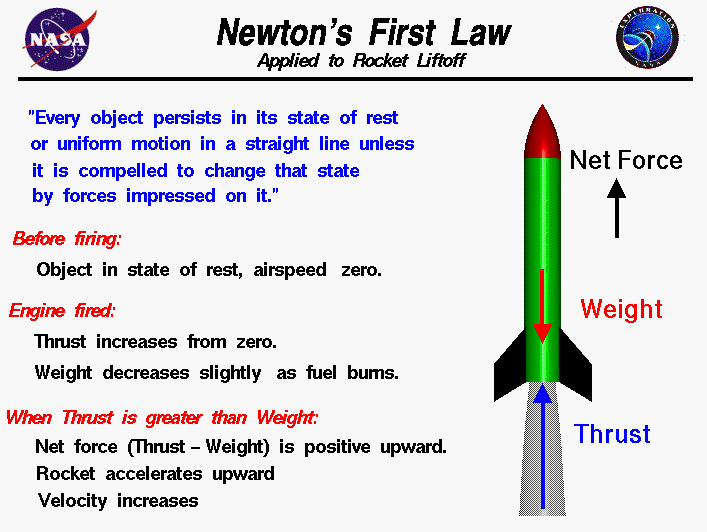
Sir Isaac Newton first presented his iii laws of movement in the "Principia Mathematica Philosophiae Naturalis" in 1686. His first law states that every object remains at residuum or in uniform motion in a direct line unless compelled to change its state by the action of an external force. This is normally taken as the definition of inertia. The key betoken hither is that if there is no net strength acting on an object (if all the external forces cancel each other out) then the object maintains a constant velocity. If that velocity is null, and then the object remains at rest. If the velocity is not zero, and then the object maintains that velocity and travels in a directly line. If a net external force is applied, the velocity changes because of the force.
The liftoff of a rocket from the launch pad is a good example of this principle. Merely prior to engine ignition, the velocity of the rocket is cypher and the rocket is at rest. If the rocket is sitting on its fins, the weight of the rocket is balanced by the re-activity of the world to the weight as described by Newton's tertiary constabulary of motion. There is no net forcefulness on the object, and the rocket would remain at rest indefinitely. When the engine is ignited, the thrust of the engine creates an boosted force opposed to the weight. Equally long as the thrust is less than the weight, the combination of the thrust and the re-action forcefulness through the fins balance the weight and there is no net external strength. The rocket stays on the pad. When the thrust is equal to the weight, there is no longer any re-action force through the fins, simply the internet force on the rocket is notwithstanding nil. When the thrust is greater than the weight, there is a net external force equal to the thrust minus the weight, and the rocket begins to rise. The velocity of the rocket increases from cypher to some positive value under the acceleration produced by the net external force.
Equally the rocket velocity increases, it encounters air resistance, or aerodynamic drag, which opposes the motion. Drag increases equally the square of the velocity. The thrust of the rocket must be greater than the weight plus the drag for the rocket to go on accelerating. If the thrust becomes equal to the weight plus the drag, the rocket continues to climb at a fixed velocity, simply information technology does not accelerate. This flight status is frequently encountered past model rockets because of the depression thrust and high drag of their design. Total scale rockets unremarkably have sufficient excess thrust to continue accelerating. Drag somewhen begins to decrease because drag depends on the air density and density decreases with increasing distance.
Guided Tours
Activities:
Fundamental Terminology: Class 10-12
Related Sites:
Rocket Alphabetize
Rocket Habitation
Beginner's Guide Home
Source: https://www.grc.nasa.gov/www/k-12/rocket/newton1r.html
0 Response to "How Can Newton's Law of Actionã¢â‚¬â€œreaction Best Be Applied to Explain the Movement of a Rocket?"
Post a Comment